
For many factories, Annual Return Form 27 is treated like a year-end formality. The date approaches, the team starts collecting data, old registers are opened, wage records are checked, accident records are searched, and the return is prepared in a hurry.
At first glance, this may look manageable.
But in reality, Form 27 is not just a form submission. It is a yearly compliance summary of how the factory has operated during the year.
This is where many businesses make a mistake. They wait until the last date and assume that the return can be filed quickly once the deadline comes closer. But Form 27 depends on multiple records that are created throughout the year. If those records are incomplete, inconsistent, or outdated, the final return becomes difficult to prepare accurately.
Under the Maharashtra Factories Rules, 1963, the manager of every factory is required to submit the annual return in Form 27 on or before 1st February of each year. The return includes important information such as average number of workers employed daily, working hours, leave with wages, discharged or dismissed workers, wages in lieu of leave, compensatory holidays, welfare facilities, accidents, and other prescribed details.
This means Form 27 is not only a deadline-based task. It is a reflection of the factory’s compliance discipline for the entire year.
In this blog, we will understand why factories should not wait until the last date for Annual Return Form 27, how last-minute filing creates compliance risk, and what businesses must do to stay prepared.
What Is Annual Return Form 27 and Why It Matters
Annual Return Form 27 is a statutory return required under factory compliance. It captures important information about the factory’s workforce, working conditions, welfare facilities, leave records, accident details, and other operational compliance data for the year.
The purpose of this return is not just to submit information to the authority. It helps show whether the factory has maintained required records and followed applicable compliance responsibilities throughout the year.
For a factory, Form 27 matters because it connects multiple compliance areas into one annual document. It is linked with worker records, attendance, leave, wages, working hours, holidays, accident reporting, and welfare provisions.
This is why the form should not be seen as a simple upload or submission task.
If the records behind the form are weak, the return becomes weak.
If the return is inaccurate, it may create questions during inspection or audit.
In simple terms, Annual Return Form 27 is not just paperwork. It is a yearly compliance report card for the factory.
The Hidden Complexity Behind a “Simple Annual Return”
Many factories assume that Annual Return Form 27 can be prepared at the end of the year by checking a few registers and entering basic details.
However, the actual process is more detailed.
The return requires information that comes from different departments and records. HR may have worker details. Payroll may have wage and leave information. Safety teams may have accident data. Admin teams may have welfare facility records. Compliance teams may have registers and statutory documents.
If these records are not maintained properly throughout the year, collecting accurate information at the last moment becomes difficult.
For example, if leave records were not updated regularly, the leave with wages section may become confusing. If accident details were not recorded properly, the return may not reflect correct information. If worker strength changed during the year, the average number of workers employed daily must be calculated carefully.
This hidden complexity is the reason last-minute filing creates risk.
The form may look simple, but the data behind it is not simple.
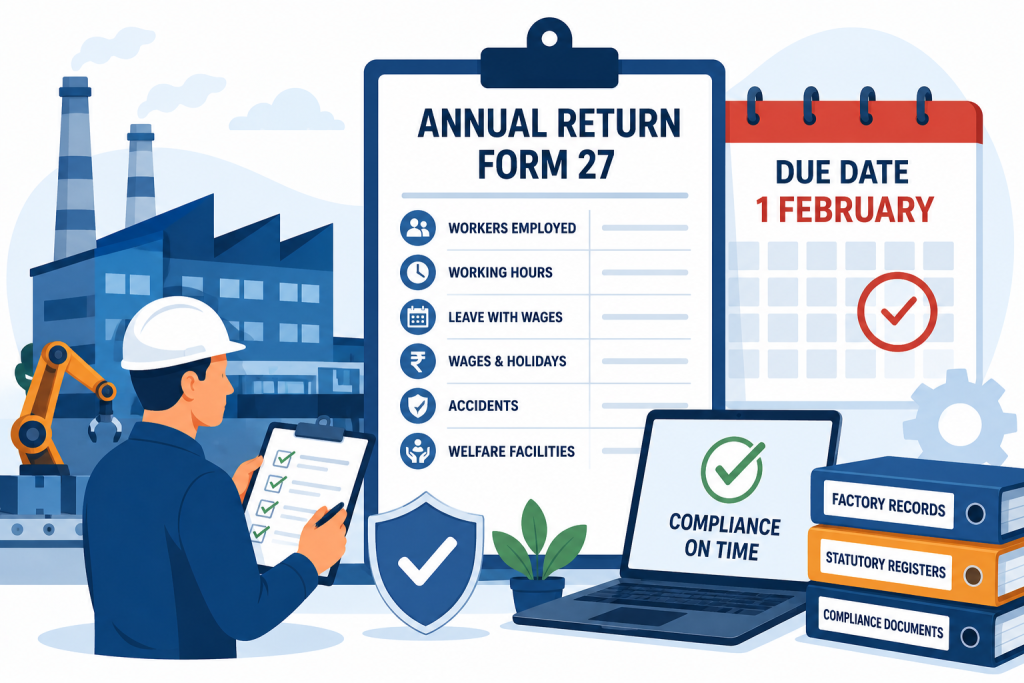
The Real Timeline: How Waiting Until the Last Date Creates Compliance Risk
The risk usually starts when the factory treats Form 27 as a deadline task instead of a year-long compliance process.
At the beginning of the year, daily operations take priority. Production, manpower planning, attendance, shifts, wage processing, and dispatch schedules become the main focus. Compliance records may be maintained, but not always reviewed in a structured manner.
As months pass, small gaps begin to appear. Leave records may not be updated properly. Overtime or working hour details may not match across records. Accident registers may not be reconciled. Worker count may change, but records may not be reviewed monthly. Welfare facility details may be available, but not properly documented.
At this stage, there may be no visible problem because operations continue normally.
The issue becomes serious when the deadline approaches.
The team suddenly starts collecting data from different registers and departments. They realize that some information is missing, some records do not match, and some details require clarification. Instead of reviewing the return calmly, the factory starts correcting records under pressure.
This is when mistakes happen.
Wrong figures may be entered. Incomplete data may be submitted. Previous records may be copied without proper verification. Some information may be estimated instead of being calculated correctly.
The problem becomes bigger if the return is submitted late or inaccurately. The factory may face questions during future inspections, audits, or compliance reviews. Authorities may ask for supporting documents behind the return. If the submitted data does not match registers or actual records, the factory may have difficulty explaining the difference.
This is how a simple delay can become a compliance risk.
Why Form 27 Should Not Be Treated as a Last-Minute Task
Annual Return Form 27 should not be prepared only when the deadline comes close because the form depends on records created throughout the year.
A factory cannot accurately prepare annual compliance data if monthly records are incomplete.
For example, details related to workers, working hours, leave, compensatory holidays, and accidents cannot be created properly at the end of the year unless the factory has maintained proper records during the year.
The return is only the final stage.
The real compliance happens every month.
When factories wait until the last date, they reduce the time available for verification. This increases the chance of mistakes, missing information, wrong calculations, and inconsistent reporting.
A factory that prepares early has time to review records, identify gaps, correct errors, collect missing documents, and submit the return with confidence.
A factory that waits until the last date usually files under pressure.
And compliance done under pressure is never the safest approach.
Why Accuracy Matters More Than Just Filing
Many businesses believe that filing the return before the deadline is enough.
But filing is only one part of compliance.
Accuracy is equally important.
Annual Return Form 27 should match the factory’s internal records. If the return mentions certain worker numbers, leave details, accident records, or welfare information, the factory should be able to support those details with proper documentation.
If the return is filed with incorrect or inconsistent information, it can create problems later.
During inspection, the authority may compare the submitted return with registers and factory records. If differences are found, the factory may be asked to explain them.
This is why businesses should not focus only on “submission done.”
They should focus on “submission done correctly.”
A return filed on time but prepared carelessly can still create compliance risk.
Why Monthly Compliance Review Makes Form 27 Easier
The easiest way to prepare Form 27 correctly is to avoid waiting until the end of the year.
Factories should review key compliance records every month.
Monthly review helps ensure that attendance, leave, wages, worker count, accident records, compensatory holidays, working hours, and statutory registers are updated regularly.
When this is done consistently, Annual Return Form 27 becomes easier to prepare because the data is already available, reviewed, and reliable.
Instead of searching for missing records at the last moment, the team only needs to consolidate verified information.
This reduces stress, saves time, and improves accuracy.
For factories, monthly compliance review is not extra work. It is a system that prevents year-end compliance pressure.
The Cost of Ignoring Form 27 Preparation
Ignoring Form 27 preparation may not create an immediate problem, but the long-term impact can be serious.
If the return is delayed, incorrect, or unsupported by proper records, the factory may face compliance questions. It may also create difficulty during inspection, license-related reviews, statutory audits, or internal compliance checks.
The bigger cost is not only penalty or notice risk.
The bigger cost is loss of control.
When records are not reviewed regularly, the factory does not know where the gaps exist. By the time the annual return is due, those gaps may have already become difficult to correct.
This creates unnecessary pressure on HR, admin, payroll, safety, and compliance teams.
A factory that manages Form 27 properly shows that it has control over its records.
A factory that struggles at the last moment shows that its compliance system needs improvement.
Conclusion
Annual Return Form 27 is not just a deadline to remember.
It is a compliance responsibility that reflects how the factory has maintained records throughout the year.
Factories that wait until the last date often face unnecessary pressure, missing data, incorrect figures, and documentation gaps. These problems can create risks during inspections, audits, or future compliance reviews.
The safer approach is to treat Form 27 as a year-long compliance process.
When records are reviewed monthly, departments coordinate properly, and data is verified early, filing becomes smoother and more accurate.
The companies that take Form 27 seriously stay better prepared, reduce compliance risk, and maintain stronger control over factory records.
The ones that delay it often face problems that could have been avoided with timely planning.
The difference lies in whether the factory treats Annual Return Form 27 as a last-date task or as a compliance discipline.
If your factory needs support with Form 27 preparation, record review, or factory compliance documentation, OM Management Consultants can help you stay prepared, accurate, and inspection-ready.
