India

Trade Unions Act, Industrial Disputes Act and Standing Orders Act Officially Repealed

New Delhi:In a major legal shift, the Government of India has formally repealed three cornerstone labour laws following the nationwide implementation of the Industrial Relations Code, 2020.The laws repealed with effect from 21 November 2025 are: Trade Unions Act, 1926 Industrial Employment (Standing Orders) Act, 1946 Industrial Disputes Act, 1947 This repeal was notified by

Trade Unions Act, Industrial Disputes Act and Standing Orders Act Officially Repealed Read More »

Gig Workers and Contract Staff Brought Under India’s Social Security System

New Delhi:India has taken a major step towards workforce inclusion by extending social security coverage to gig workers, platform workers, freelancers and contract employees.These workers will now be eligible for: Insurance Medical benefits Pension schemes Accident coverage This change benefits millions working in food delivery, ride-hailing, logistics, freelancing and digital platforms.

Gig Workers and Contract Staff Brought Under India’s Social Security System Read More »

Flexible Working Hours and 4-Day Workweek Legally Permitted Under New Labour Law

New Delhi:India’s new labour framework introduces flexibility in how employees can work their weekly hours, allowing businesses to implement four-day workweeks and other flexible schedules.Under the new rules, employees may work: 4 days × 12 hours 5 days × about 9.5 hours 6 days × 8 hours As long as the total does not exceed

Flexible Working Hours and 4-Day Workweek Legally Permitted Under New Labour Law Read More »

Standing Orders Under the New Labour Codes: What Employers Need to Know

The introduction of the Industrial Relations Code, 2020 marks a significant shift in India’s labour law framework, particularly with respect to Standing Orders. Standing Orders are written rules that define the terms of employment and regulate conditions of service such as classification of workers, working hours, attendance, leave, misconduct, disciplinary procedures, and termination. These rules

Standing Orders Under the New Labour Codes: What Employers Need to Know Read More »

Labour Welfare Fund (LWF) Compliance Update: Key Obligations for Employers Across India

The Labour Welfare Fund (LWF) is a statutory contribution mandated under various state labour welfare legislations in India, aimed at promoting the well-being of workers employed in industrial, commercial, and other organized establishments. The fund is utilized to provide social security benefits, healthcare support, educational assistance, housing facilities, and recreational amenities for workers and their

Labour Welfare Fund (LWF) Compliance Update: Key Obligations for Employers Across India Read More »

Big EPFO Shocker 2026: Employees Can Now Withdraw 100% PF After Just 12 Months – Full Details Inside

In a major relief for crores of salaried employees across India, the Employees’ Provident Fund Organisation (EPFO) has rolled out new PF withdrawal rules for 2026, making it significantly easier for members to access their provident fund savings. Under the revised rules, employees who have completed just 12 months of service are now eligible to

Big EPFO Shocker 2026: Employees Can Now Withdraw 100% PF After Just 12 Months – Full Details Inside Read More »

Minimum Wage Now Mandatory for All Workers, Including Contract and Gig Staff

New Delhi:In a major reform aimed at strengthening worker protection, the government has made minimum wages mandatory for all workers, regardless of their job type, industry, or employment arrangement. Earlier, minimum wage laws applied only to specific “scheduled employments,” leaving a large section of India’s workforce outside legal wage protection. Under the new system, every

Minimum Wage Now Mandatory for All Workers, Including Contract and Gig Staff Read More »

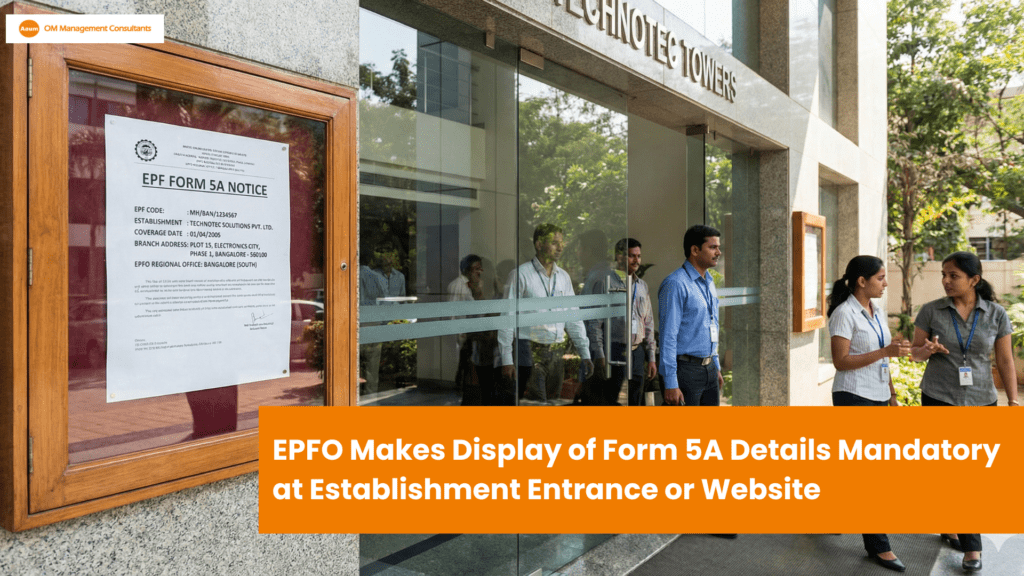
EPFO Makes Display of Form 5A Details Mandatory at Establishment Entrance or Website

New Delhi, October 7, 2025: The Employees’ Provident Fund Organisation (EPFO) has directed all establishments covered under the EPF & MP Act, 1952 to prominently display key details from Form 5A either at the entrance of the premises or on the establishment’s website and mobile application. The directive has been issued under the powers of

EPFO Makes Display of Form 5A Details Mandatory at Establishment Entrance or Website Read More »

EPFO Launches Revamped ECR System for September 2025 Wage Month

EPFO Launches Revamped ECR System for September 2025 Wage Month

New Delhi, September 26, 2025: The Employees’ Provident Fund Organisation (EPFO) has announced the launch of a revamped Electronic Challan-cum-Return (ECR) system for all establishments, applicable from the wage month of September 2025 onwards. The new module has been released in beta form and is accessible through the EPFO employer portal. EPFO said the redesigned

EPFO Launches Revamped ECR System for September 2025 Wage Month Read More »

Scroll to Top