
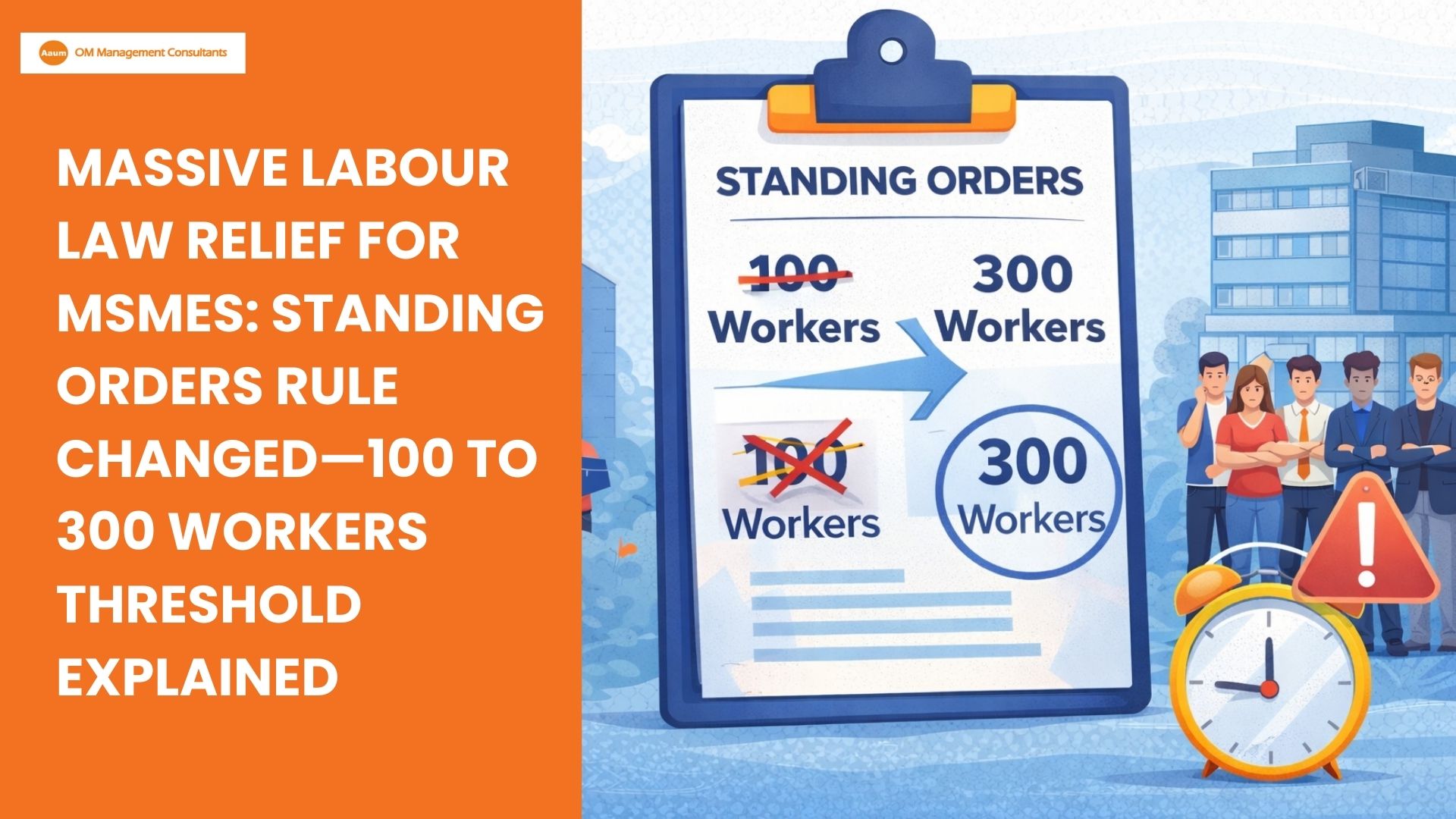
In a major pro-business reform under India’s new labour law framework, the government has officially increased the applicability threshold for Standing Orders from 100 workers to 300 workers under the Industrial Relations Code, 2020 (IR Code). This change has come as a huge relief for MSMEs, startups, and mid-sized companies, drastically reducing compliance pressure that existed under the old law.
Earlier, establishments employing 100 or more workers were mandatorily required to frame, certify, and implement Standing Orders under the Industrial Employment (Standing Orders) Act, 1946. This process was often seen as complex, time-consuming, and inspection-heavy, especially for growing businesses. With the new threshold of 300 workers, thousands of establishments have now moved out of mandatory Standing Orders compliance.
What Are Standing Orders and Why Were They a Compliance Burden?
Standing Orders are formal written rules governing conditions of employment. They cover sensitive and critical matters such as:
● Classification of workers (permanent, temporary, fixed-term, probationers)
● Working hours, shifts, holidays, and attendance
● Late coming and leave rules
● Termination, notice period, and retrenchment
● Disciplinary action, suspension, dismissal
● Grievance redressal mechanisms
Under the old regime, once an establishment crossed the 100-worker limit, it had to draft Standing Orders, consult unions, submit them for certification to labour authorities, respond to objections, and implement them within a fixed timeline. Any deviation could trigger disputes, inspections, and litigation.
For MSMEs and fast-growing companies, this often meant loss of flexibility and increased legal exposure.
What Has Changed Under the Industrial Relations Code, 2020?
The Industrial Relations Code, 2020 has significantly revamped this framework. The mandatory applicability threshold has now been increased to 300 workers, meaning:
● Establishments with less than 300 workers are no longer legally required to have certified Standing Orders
● The compliance burden on MSMEs has been substantially reduced
● Employers have greater operational flexibility in managing workforce policies
This change aligns with the government’s broader objective of “Ease of Doing Business” and encouraging formal employment without over-regulation.
Who Still Needs to Comply with Standing Orders?
The relief is not universal. Large establishments employing 300 or more workers must still fully comply with Standing Orders requirements under the IR Code.
Such employers are required to:
● Draft Standing Orders based on Model Standing Orders
● Consult the Negotiating Union or Negotiation Council
● Submit Standing Orders for certification to the Certifying Officer
● Address objections and finalize certification
● Implement certified Standing Orders within 6 months
Failure to comply can attract penalties, disputes, and legal challenges, especially during disciplinary actions or termination cases.
Why This Is a Game-Changer for MSMEs
Labour law experts believe this reform will:
● Reduce inspection and litigation risk for MSMEs
● Encourage scaling up of workforce without fear
● Improve employer flexibility in HR policies
● Lower administrative and compliance costs
● Reduce union-related procedural complications in mid-sized units
Earlier, many employers deliberately avoided crossing the 100-employee mark to escape Standing Orders obligations. With the new 300-worker threshold, this artificial barrier has been removed, allowing businesses to expand more confidently.
Workers’ Perspective: A Double-Edged Sword?
While employers have welcomed the change, some worker groups have expressed concern. Standing Orders provide clarity and legal protection to workers regarding service conditions and disciplinary procedures.
With the threshold raised, employees working in establishments with 100–299 workers may now have less statutory protection, as rules will be governed more by internal policies than certified Standing Orders.
However, the government maintains that:
● Core protections under wage laws, social security, and safety codes remain intact
● Fixed-term employment and grievance redressal mechanisms are still regulated
● The reform balances worker protection with business flexibility
Does This Mean No Rules for Smaller Establishments?
No. Even if Standing Orders are not mandatory, employers must still comply with:
● Employment contracts and appointment letters
● Wage laws and minimum wages
● PF, ESIC, gratuity, and social security laws
● Workplace safety and health regulations
● Principles of natural justice during disciplinary actions
In fact, experts strongly advise MSMEs to voluntarily adopt well-drafted HR policies, even if Standing Orders are not legally required. Clear internal rules help prevent disputes and protect employers during litigation.
What Employers Should Do Now
With the Standing Orders rule officially changed, employers should:
● Review current employee strength
● Identify whether the 300-worker threshold applies
● Reassess existing Standing Orders (if any)
● Update HR policies and employee handbooks
● Prepare in advance if expansion may cross 300 workers
Proactive planning can help employers avoid last-minute compliance stress when workforce numbers grow.
The increase of the Standing Orders threshold from 100 to 300 workers under the Industrial Relations Code, 2020 is one of the most impactful labour law reforms for MSMEs in recent years. It reduces red tape, supports business growth, and aligns labour regulation with modern workforce realities.
