
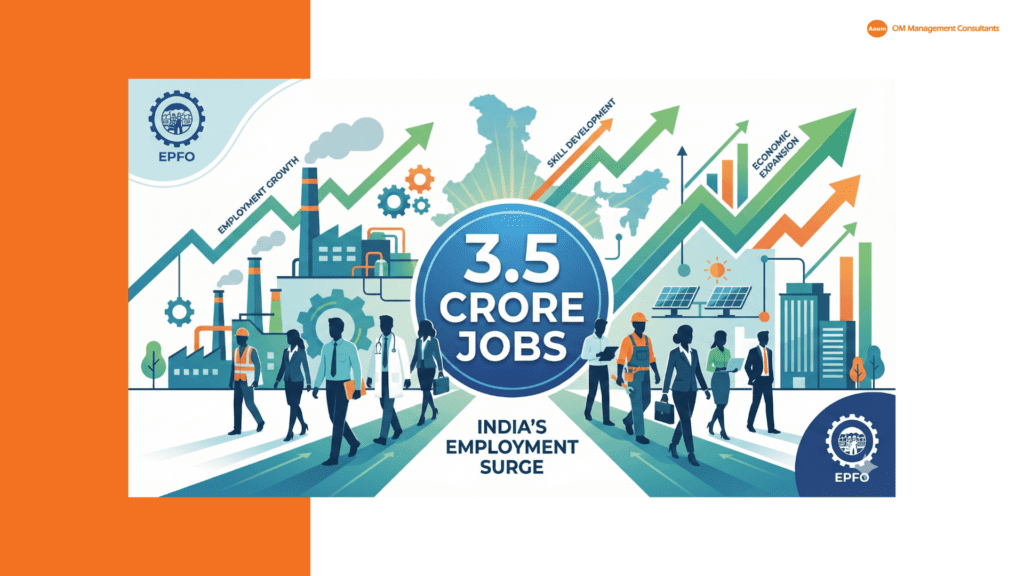
New Delhi, July 1, 2025 — In a major push toward employment generation and workforce formalization, the Union Cabinet chaired by Prime Minister Narendra Modi has approved the Employment Linked Incentive (ELI) Scheme, aimed at boosting job creation, improving employability, and expanding social security across all sectors — with special emphasis on the manufacturing industry.
The ELI Scheme, first announced in the Union Budget 2024–25 as part of the Prime Minister’s package of five major initiatives, forms a key component of the government’s plan to provide employment, skilling, and economic opportunities to 4.1 crore youth, backed by a total outlay of ₹2 lakh crore.
₹99,446 Crore Outlay to Create 3.5 Crore Jobs
The newly approved ELI Scheme carries a substantial budget of ₹99,446 crore, with the objective of generating over 3.5 crore jobs within a two-year period. Officials estimate that 1.92 crore of these will be first-time entrants into the Indian workforce.
The scheme will apply to new jobs created between August 1, 2025, and July 31, 2027.
Two-Part Scheme: Support for Employees and Employers
The scheme is structured into two components — Part A for first-time employees, and Part B for employers generating additional employment.
Part A: Incentives for First-Time Employees
Part A focuses on encouraging youth to join the workforce for the first time. Key features include:
- Eligible first-time employees (registered with EPFO) will receive one month’s EPF wage, up to ₹15,000, in two instalments.
- Employees with salaries up to ₹1 lakh per month qualify.
- Instalments are structured as:
- 1st instalment: After 6 months of continuous service
- 2nd instalment: After 12 months of service and completion of a financial literacy programme
- 1st instalment: After 6 months of continuous service
- A portion of the incentive will be deposited in a savings instrument or fixed account to promote long-term savings behavior.
The benefit is expected to cover around 1.92 crore first-time employees.
Part B: Incentives for Employers Creating Additional Jobs
Part B is designed to support establishments in all sectors, with additional benefits for manufacturing units.
Employer Incentives:
- Incentives apply to employees earning up to ₹1 lakh per month.
- The Government will provide:
- ₹1,000 per month for additional employees with EPF wages up to ₹10,000
- ₹2,000 per month for EPF wages between ₹10,000 and ₹20,000
- ₹3,000 per month for EPF wages above ₹20,000 up to ₹1 lakh
- ₹1,000 per month for additional employees with EPF wages up to ₹10,000
Employment Thresholds:
- Establishments must hire:
- At least 2 additional employees (if current workforce < 50)
- At least 5 additional employees (if workforce ≥ 50)
- At least 2 additional employees (if current workforce < 50)
- Employment must be sustained for at least six months to qualify.
Extended Benefits for Manufacturing Sector
- Manufacturing employers will receive incentives for up to four years (two-year base period + two additional years).
Part B is expected to facilitate the creation of 2.60 crore additional jobs across sectors.
Direct Benefit Transfer-Based Disbursement
The government has outlined a clear, technology-backed payment mechanism:
Part A (First-Time Employees):
Payments will be disbursed via Direct Benefit Transfer (DBT) using the Aadhaar-Based Payment System (ABPS).
Part B (Employers):
Incentives will be deposited directly into PAN-linked bank accounts of eligible establishments.
Boost to Manufacturing and Workforce Formalization
According to the Regional PF Commissioner (Bengaluru Central), the ELI Scheme is expected to act as a catalyst for employment growth, particularly in the manufacturing sector, while simultaneously expanding formal social security coverage through EPFO.
By incentivizing both employers and new entrants, the scheme aims to strengthen India’s workforce, promote job stability, and advance the government’s broader goal of building a secure and skilled labor ecosystem.
